XR Twin Lab: Michelson Interferometer: Advanced Setup for Lab Training

XR Twin Lab: Michelson Interferometer: Advanced Setup for Lab Training

Friedrich Schiller Universität Jena
Online
1 ECTS
Phortify Self-standing Modules

XR Twin Lab: Michelson Interferometer: Advanced Setup for Lab Training

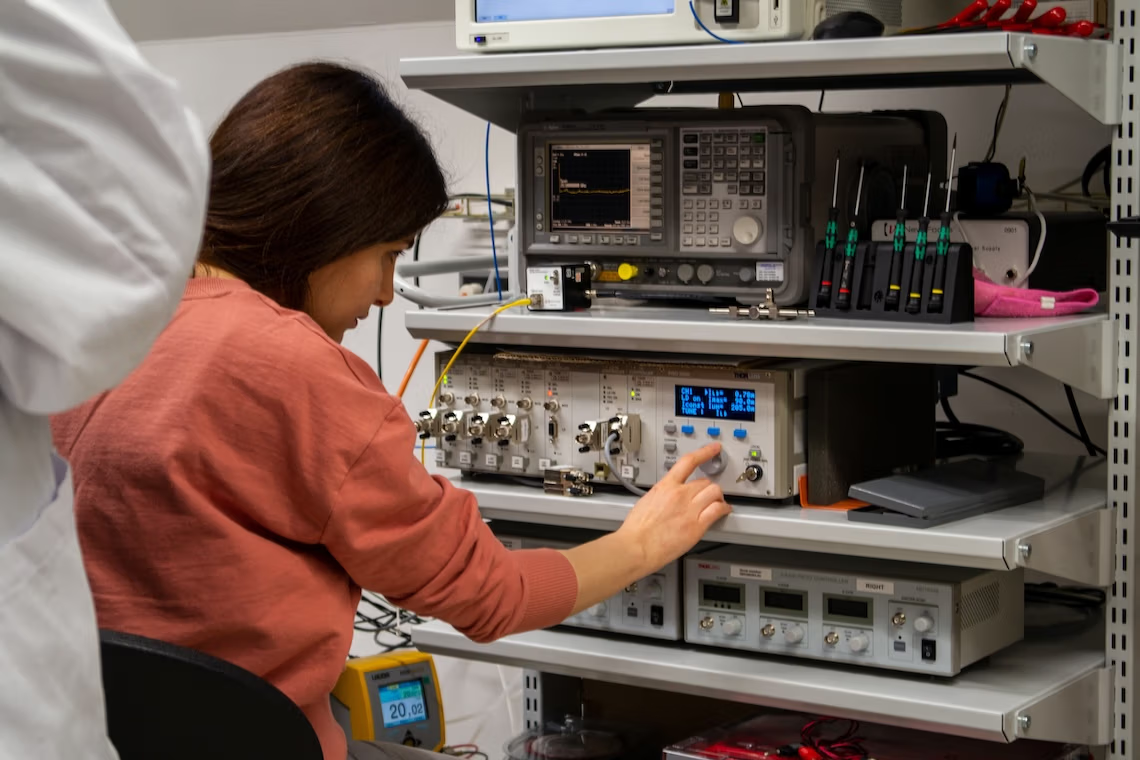
Compared to the previously described XR Twin Lab Michelson Interferometer, this is an Advanced Version that offers many more degrees of freedom and is connected to a series of tasks and tutorials which a student can fulfill fully remotely. The original, analogue setup is located in a locked space at the Abbe Center of Photonics in Jena, but it can be remotely controlled. Some initial preparation and alignment onsite is necessary to run the setup.

Organisers

Friedrich Schiller Universität Jena

Delivery mode

Online

Location

Online

Timing

On Demand

Target audience

BSc students
MSc students

Language

English

Learning outcomes

After successful completion of the module, students are able to:

  • explain the physical principles of optical interference and coherence, particularly in the context of the Michelson interferometer.
  • analyze interference patterns and fringe shifts to determine physical quantities such as laser wavelength, refractive index, and thermal expansion coefficients.
  • apply interferometric measurement techniques to investigate optical and material properties with high precision.
  • evaluate the coherence properties of different light sources, including lasers and LEDs, and relate them to the formation of interference patterns.
  • operate and control an interferometric experimental setup, including remote-controlled laboratory instrumentation and data acquisition systems.
  • interpret experimental data and estimate measurement uncertainties in interferometric experiments.
  • present and discuss experimental results in a scientifically structured manner, linking theoretical concepts with experimental observations.

Topical Area(s) covered in this module

Instrumentation & metrology

Duration or workload

1 ECTS

Competence level

Intermediate

Temporal mode

Flexible self-paced
Scheduled sessions (real-time participation required)

Timing and availability

On Demand

Learning formats

Lab training
Exercises
Independent study
Project work

Pricing

Free

Target audience

BSc students
MSc students

Entry requirements

Students should have prior knowledge of: basic optics, including reflection, refraction, interference, and diffraction fundamental concepts of wave optics and coherence basic experimental physics and laboratory practice, including measurement techniques and uncertainty estimation introductory mathematics and data analysis relevant to physical measurements Basic familiarity with laser sources and optical components (mirrors, beam splitters, detectors) is recommended.

Organisers

UniJena logo
Friedrich Schiller Universität Jena

Contact

Dr. 

Tobias 

Gäbler

Dr. 

Christian 

Helgert

Ready to get started?

Pilot Call for Funding now open

MyPhortify is free to use. Creating an account does not commit you to an application.