Electronics for Photonic Integrated Circuits

Electronics for Photonic Integrated Circuits

Ghent University
ePIXfab
Online
4 ECTS
Phortify Self-standing Modules

Electronics for Photonic Integrated Circuits

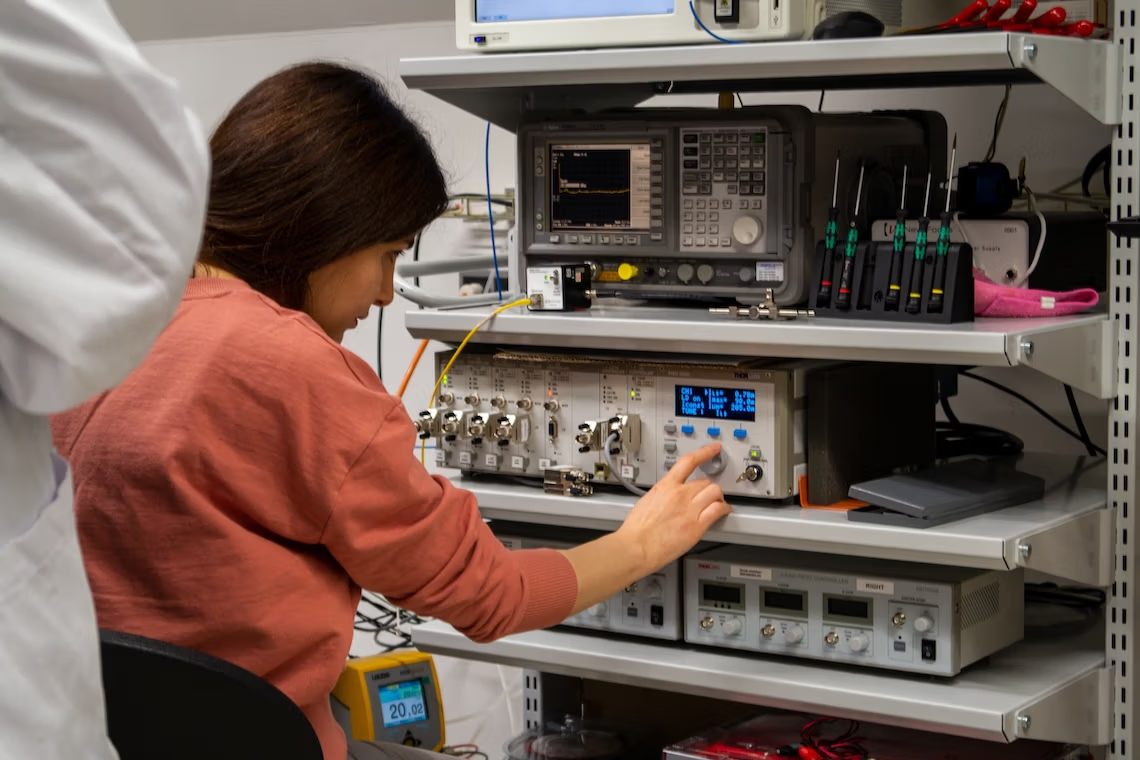
Photonic chips power applications in telecommunications, artificial intelligence, sensing, signal processing and quantum technology. As these chips get faster and more complex, they need specially co-designed electronics to control, drive and read out their photonic components. This expertise is often limited to specialists. This micro-credential gives non-specialists the basics they need: the electronic functions and circuits used in photonic systems, electronic–photonic co-design, and high-frequency effects and interconnects. It also includes lab demonstrations on characterising photonic chips and optical transceivers.

Organisers

Ghent University
ePIXfab

Delivery mode

Online

Location

Online

Timing

Fixed Schedule

Target audience

MSc students
PhD researchers
Academic staff
Industry Professionals

Language

English

Learning outcomes

Understand the functions and design trade-offs in optical transceiver circuits and architectures, Understand photonic device models, high-frequency effects in electronic–photonic co-design and interfaces, signal integrity, transmission lines and matching circuits,
Analyse and characterise the performance of optical transceivers, Connect with specialised IC and transceiver designers

Topical Area(s) covered in this module

Integrated photonics

Instrumentation & metrology

Duration or workload

4 ECTS

Competence level

Advanced

Temporal mode

Flexible self-paced
Scheduled sessions (real-time participation required)

Timing and availability

Fixed Schedule

Tuesdays 14:30–17:30, 29 September – 8 December 2026. Sessions can be followed online via Teams and are recorded.

Learning formats

Lecture
Exam

Pricing

€363.80

Target audience

MSc students
PhD researchers
Academic staff
Industry Professionals

Entry requirements

Basic background in electronic circuits and electromagnetics, and at least a bachelor's degree in Industrial Engineering or Engineering (Bachelor of Science).

Assessment method(s)

Exam

Exam format

Online (flexible window)

Organisers

UGent logo
Ghent University
ePIXfab

Contact

Johan  

Bauwelinck

Secret Link