Optical Sensors

VUB
Hybrid
4 ECTS
Phortify Self-standing Modules

Optical Sensors

This course consists of a series of lectures to introduce how a light signal can be used to measure the most common physical quantities such as distance, displacement, speed, acceleration, temperature, mechanical forces and deformation.

The course serves a twofold purpose. First, it gives an overview of the different physical mechanisms through which an optical sensor changes the characteristics of a light signal by allowing it to interact with a physical measurand. We therefore review the most important characteristics of an optical signal, such as coherence, polarization, wavelength, intensity, and phase, the principles of interferometry, the Bragg condition, and the elasto-optic effect.

Second, it describes how optical sensors are built, what their main specifications are, and which aspects one has to consider for building an effective sensor.

Both free-space optical sensors and optical fiber sensors are investigated. Free-space sensors are applied to the measurement of distance and displacement; speed and acceleration; and temperature. This includes techniques such as time-of-flight (e.g., LiDAR), interferometric displacement sensors, and infrared thermometry using blackbody radiation.

Optical fiber point sensors based on interferometry, Bragg gratings, or distributed sensing are compared, and the potential of multiplexing is studied. Specific types such as Fabry-Pérot, Mach-Zehnder, and Michelson interferometers in fiber are discussed, as well as distributed techniques like OFDR (Optical Frequency Domain Reflectometry).

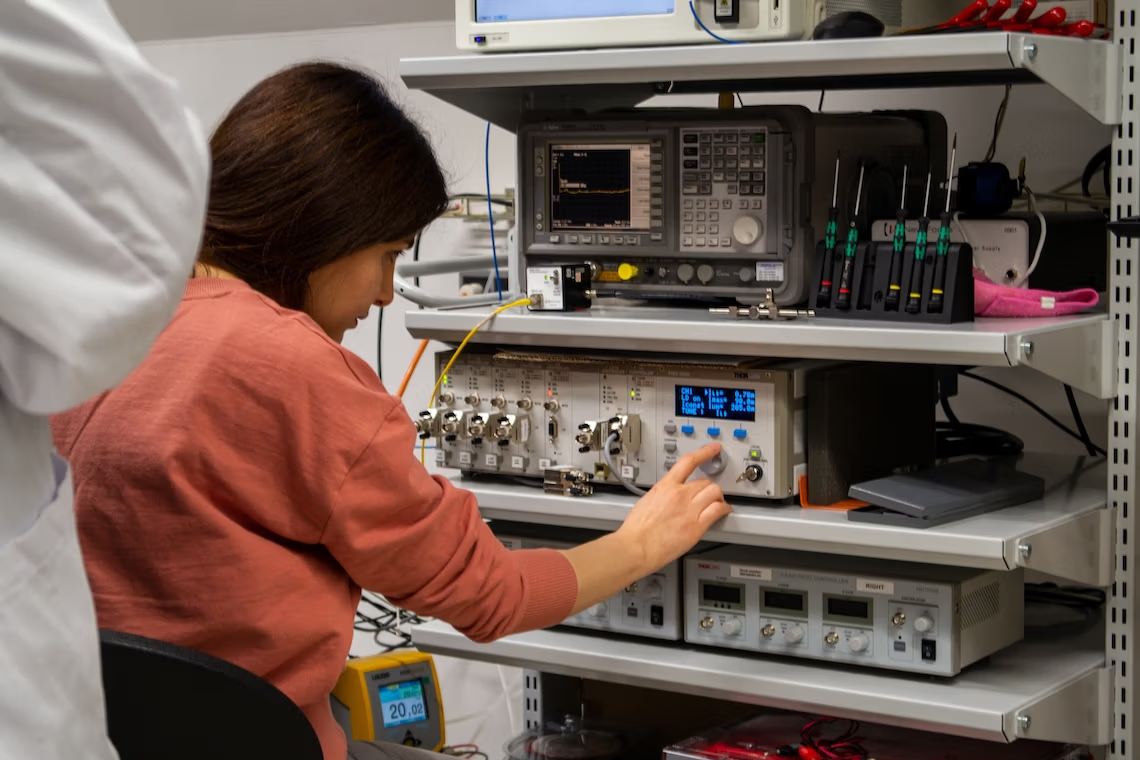
The practical component includes laboratory work with FBG and OFDR-based sensors for strain and temperature sensing, and a poster assignment where students present recent research on experimental optical sensors.

Organisers

VUB

Delivery mode

Hybrid

Location

Online and Brussels, Belgium

Timing

Fixed Schedule

Target audience

BSc students
MSc students
PhD researchers
Academic staff
Industry Professionals

Language

English

Learning outcomes

  • Understand the most important optical measurement techniques for physical sensing.
  • Select and apply the appropriate optical sensor technology for specific measurement challenges.
  • Master and apply advanced engineering knowledge in photonics to solve complex problems.
  • Thoroughly understand and apply specialized techniques in the field of photonics.
  • Be acquainted with recent innovation trends in optical sensing and photonic systems.
  • Have knowledge of key application areas of photonic materials, components, and sensing systems.
  • Perform research based on scientific literature and assess the relevance of scientific sources.
  • Analyze own experimental results and results of others in an objective and critical manner.
  • Understand and interpret the context of technical or scientific papers in photonics, investigating unclear parts independently.
  • Take independent positions on complex measurement and sensor selection problems, and defend these viewpoints convincingly.
  • Communicate effectively about the field of specialization in English, both orally and in writing.
  • Report technical and scientific topics clearly and professionally, including the use of graphical materials.
  • Fabricate, calibrate, and characterize optical fiber sensors using standard photonic instrumentation.
  • Interpret instrumentation manuals and work independently with photonic measurement equipment.
  • Function effectively as a member of an international and multidisciplinary team.
  • Act in an ethical, professional, and socially responsible manner.

Topical Area(s) covered in this module

Optical sensors & detectors

Duration or workload

4 ECTS

Competence level

Intermediate

Temporal mode

Scheduled sessions (real-time participation required)

Timing and availability

Fixed Schedule

Learning formats

Lecture
Lab training
Exam

Pricing

€ 363,80

Target audience

BSc students
MSc students
PhD researchers
Academic staff
Industry Professionals

Entry requirements

Intermediate knowledge in optics.

Assessment method(s)

Exam
Oral presentation
Lab demonstration

Exam format

On-campus (scheduled)

Organisers

VUB logo
VUB

Contact

Prof. Dr. In. 

Heidi 

Ottevaere

Ready to get started?

Pilot Call for Funding now open

MyPhortify is free to use. Creating an account does not commit you to an application.